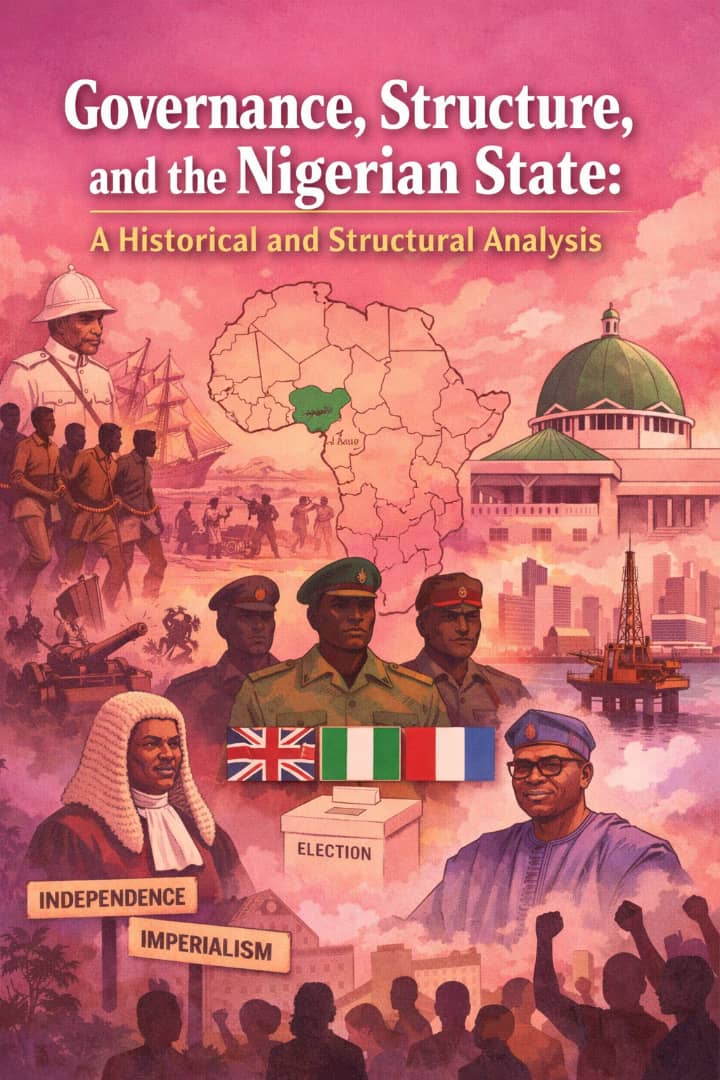
Introduction: Understanding Governance Beyond Popular Perception
Governance is one of the most misunderstood concepts in modern political discourse, particularly within developing states such as Nigeria. For many citizens, governance is often reduced to immediate material expectations—jobs, subsidies, infrastructure, and direct welfare. However, this perception, while understandable, is fundamentally incomplete.
Governance, in its true sense, refers to the systems, structures, institutions, and processes through which a state is organized and administered. It is not merely about outcomes but about the framework that produces those outcomes. When this framework is weak, misaligned, or improperly constructed, even the most well-intentioned leadership will struggle to deliver meaningful progress.
This misunderstanding has led to a recurring pattern in Nigeria: citizens expect results from a system whose foundational structures they neither fully understand nor critically examine.
To properly evaluate governance in Nigeria today—and to make informed electoral decisions—it is necessary to begin with a foundational question: What kind of system is Nigeria operating, and is it suited to its realities?
Systems of Government and Political Ideology
Every state operates within a system of governance shaped by its political ideology. Political ideology refers to the set of ideas, principles, and socio-economic beliefs that guide how a society organizes power, distributes resources, and governs its people.
Different societies adopt different systems based on historical, cultural, economic, and demographic factors. Among the major systems and ideologies are:
Communalism, which emphasizes collective ownership of resources and shared responsibility within a community. This system was notably advanced in post-colonial Africa by Julius Nyerere, who promoted a model of governance centred on collective welfare and social cohesion.
Socialism, associated with Karl Marx, advocates state control over the means of production to ensure equitable distribution of resources.
Capitalism, widely practised in Western societies, emphasizes private ownership, individual enterprise, and market-driven economic activity.
Feudalism, prominent in medieval Europe, was based on land ownership and hierarchical obligations between lords and subjects.
Absolutism and autocracy, where power is concentrated in a single authority or ruler. Democracy is a system in which leaders are chosen by the people through elections. Oligarchy and plutocracy, where power resides with a small group or wealthy elite. Theocracy, where governance is based on religious authority. And anarchy, characterized by the absence of centralized authority.
These systems are not arbitrarily chosen. They emerge from specific societal conditions—such as population size, economic structure, cultural values, and historical experiences.
Realist vs. Idealist Approaches to Governance
Political ideologies can broadly be categorized into two approaches:
Realist ideology, which builds governance structures based on existing conditions—population dynamics, economic realities, and institutional capacity.
Idealist ideology, which seeks to transform society into what it ought to be, often without sufficient regard for present limitations.
Nigeria's governance model reflects a largely idealist orientation. Rather than evolving from indigenous systems or adapting carefully to its realities, it attempts to operate a model that does not fully align with its structural conditions.
Party Systems and Political Organization
Another critical component of governance is the party system—the framework through which political competition and leadership selection occur.
A one-party system restricts political activity to a single party (either constitutionally or in practice). A two-party system limits viable competition to two dominant parties. A multi-party system, such as Nigeria's, allows multiple political parties to operate.
While Nigeria formally operates a multi-party system, political power often consolidates around a few dominant parties, reflecting elements of both competitive and constrained political dynamics.
Colonial Foundations of the Nigerian State
To understand Nigeria's structural challenges, one must examine its colonial origins.
Before colonialism, the region consisted of diverse ethnic groups with distinct systems of governance. The imposition of British colonial rule introduced a foreign administrative system that did not organically evolve from local realities.
Following the Berlin Conference, European powers partitioned Africa, leading Britain to consolidate control over territories that would later become Nigeria.
In 1914, Frederick Lugard amalgamated the Northern and Southern Protectorates, creating Nigeria as a single political entity. This unification was driven by administrative convenience rather than socio-political compatibility.
Indirect Rule and Structural Consequences
The British governed Nigeria through a system known as indirect rule, where traditional rulers were used as intermediaries. While cost-effective, this system produced uneven administrative development: it was more successful in Northern Nigeria due to centralized traditional authority, and less effective in Southern regions with decentralized systems. This uneven development contributed to long-term regional disparities that persist today.
Nationalism and the Struggle for Independence
By the mid-20th century, nationalist movements began to challenge colonial rule. Key figures included Herbert Macaulay, Nnamdi Azikiwe, Obafemi Awolowo, and Ahmadu Bello. These leaders mobilized political parties, labour movements, and the press to demand self-governance, leading to Nigeria's independence in 1960.
Constitutional Development and Political Instability
Nigeria's constitutional evolution—from the Richards Constitution (1946) to later reforms—attempted to balance regional representation and national unity. However, structural weaknesses and political tensions persisted.
Post-independence Nigeria experienced ethnic and regional rivalries, weak institutional frameworks, and electoral disputes. These issues culminated in military interventions, including coups and prolonged military rule.
Military Rule and Democratic Transition
Military governments justified their interventions by citing corruption and instability. However, military rule often centralized power and suppressed democratic institutions. The annulment of the 1993 Nigerian presidential election remains a defining moment in Nigeria's democratic history.
Nigeria eventually returned to civilian rule in 1999, marking the beginning of the current democratic era.
The Structural Problem: A Nation Without Organic Formation
From slave trade to colonialism, from imposed constitutions to military disruptions, Nigeria's development has been shaped by external and reactive forces rather than deliberate internal design. The implication is clear: Nigeria operates a governance system that was never fully aligned with its foundational realities.
Separation of Powers and Legislative Dominance
The theory of separation of powers, developed by John Locke and popularized by Montesquieu, is intended to ensure balance among government branches. However, in practice, Nigeria's legislature holds significant power—including lawmaking authority, budget control, impeachment powers, and the ability to override executive vetoes. Despite this, public criticism disproportionately targets the executive branch.
Legislative Challenges in Nigeria
Key issues include laws that do not reflect modern realities, limited public awareness of legislation, weak implementation mechanisms, and overproduction of ineffective policies. These challenges hinder governance regardless of executive or judicial effort.
Reframing Governance Expectations
The government is not designed to provide everything directly to citizens. Its primary role is to build sustainable institutions, create enabling environments, and ensure long-term stability.
A Case for Strategic Leadership in 2027
Within this complex structural environment, leadership must be evaluated not only by immediate outcomes but by institutional impact.
Under Bola Ahmed Tinubu, several policy initiatives have focused on structural reforms—particularly in education financing, economic restructuring, and institutional activation. Programs such as student financing schemes and support for entrepreneurship reflect an attempt to build systems rather than distribute short-term relief.
Conclusion
Nigeria's challenges are deeply structural, rooted in history, and reinforced by institutional inconsistencies. No single administration can resolve them instantly.
However, progress depends on leadership that understands governance not as distribution but as structure-building. The decision in 2027, therefore, should not be based solely on immediate dissatisfaction but on a critical evaluation of who is most capable of strengthening the foundations upon which Nigeria's future depends.
References
- Afigbo, A. E. (2006). The Warrant Chiefs: Indirect Rule in Southeastern Nigeria, 1891–1929. Longman.
- Ake, C. (1996). Democracy and Development in Africa. Brookings Institution Press.
- Azikiwe, N. (1964). Zik: A Selection from the Speeches of Nnamdi Azikiwe. Cambridge University Press.
- Coleman, J. S. (1958). Nigeria: Background to Nationalism. University of California Press.
- Crowder, M. (1962). The Story of Nigeria. Faber and Faber.